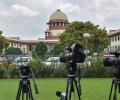
Chief Justice of India Ranjan Gogoi will administer the oath of office to the two judges on Friday, an official circular said.

The Supreme Court of India has sharply criticized the Uttar Pradesh police for filing FIRs in civil cases, stating there is a "complete breakdown of rule of law" in the state. The court expressed its displeasure after discovering FIRs filed by the UP police in civil disputes, questioning the use of criminal law in such matters. The Chief Justice highlighted the absurdity of converting civil disputes into criminal cases, emphasizing that non-payment of money cannot be considered a criminal offense. The bench has summoned the investigating officer to justify the registration of an FIR in a specific case, and has stayed criminal proceedings against the accused while allowing the cheque bounce case to continue.
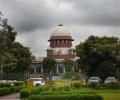
The Supreme Court of India has decided to issue a showcause notice to senior advocate Rishi Malhotra, asking why the designation conferred upon him by the apex court should not be revoked. The decision comes in the wake of allegations of misconduct against Malhotra, including suppressing material facts in multiple cases and making misleading statements despite warnings from the court. The full court, convened by Chief Justice Sanjiv Khanna, has decided to give Malhotra one more opportunity to explain his conduct before stripping him of the senior designation. The court has expressed concerns about the effectiveness of the senior designation system and whether it ensures that only deserving advocates are being designated.

The Supreme Court declined to hear a public interest litigation (PIL) seeking directions to the Election Commission and state election bodies to address purported duplication and multiple entries in voter lists. The court suggested the petitioner approach high courts with specific grievances and file representations with appropriate authorities.

The court said it is a matter of propriety but there is no legal right seeking removal of Kejriwal as chief minister following his arrest.
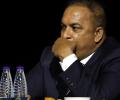
A former cricketer, Devajit Saikia represented Assam in four first-class matches during the 1990s before transitioning to cricket administration.
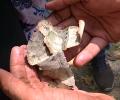
A three-member panel led by the Chief Justice of India (CJI) Sanjiv Khanna has been formed to probe the discovery of "four to five semi-burnt sacks" of Indian currency notes found after a fire at the residence of Delhi High Court judge Yashwant Varma. The incident, which occurred on March 14, has triggered an in-house inquiry, with the findings determining the judge's fate. The panel, consisting of Chief Justices Sheel Nagu (Punjab and Haryana), G S Sandhawalia (Himachal Pradesh), and Karnataka High Court judge Anu Sivaraman, will conduct a "deeper probe" into the allegations. Justice Varma has denied any knowledge of the cash being stored in the storeroom. The inquiry follows the Delhi High Court Chief Justice Devendra Kumar Upadhyaya's report that recommended a deeper investigation. The top court's 2014 guidelines for in-house procedures for probing allegations against judges will be followed during the inquiry. The panel's findings could lead to either the removal of the judge, if the misconduct is deemed serious, or a reprimand. The inquiry will also determine if the fire was indeed a short-circuit as initially reported.

Senior-most Supreme Court judge Sanjiv Khanna on Wednesday recused himself from considering pleas seeking review of the apex court's judgment last year declining legal recognition to same-sex marriage, sources said.

The West Bengal Board of Secondary Education (WBBSE) has appealed to the Supreme Court to modify its order annulling over 25,000 jobs in schools. The board argues that the termination of 11.3% of existing teachers would have a devastating impact on schools in the state and impact the education of over 78.6 lakh students. The WBBSE is seeking to allow untainted candidates to continue in service until the end of the academic year or until the process of fresh appointments is concluded, whichever is earlier.
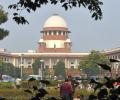
The Supreme Court on Monday said the pleas challenging the Waqf (Amendment) Act's constitutional validity will now be taken up by a bench headed by Chief Justice of India-designate Justice B R Gavai on May 15 as the incumbent CJI will be demitting office on May 13.

Podcaster Allahbadia's remarks on parents and sex on comedian Samay Raina's YouTube show 'India's Got Latent' triggered a controversy and several FIRs have been lodged against him and others in various parts of the country.
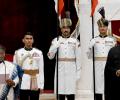
Justice Bhushan Ramkrishna Gavai was on Wednesday sworn in as the 52nd Chief Justice of India.

Quraishi asserted that India has, is and will always stand up and fight for its constitutional institutions and principles.

The NGO challenges the validity of a provision of the Chief Election Commissioner and Other Election Commissioners Act, 2023.
The Supreme Court collegium has initiated an initial inquiry against Delhi High Court judge Justice Yashwant Varma following the alleged discovery of a large stash of cash at his official residence during a fire incident. The collegium has also reportedly recommended Justice Varma's transfer to his parent high court, the Allahabad High Court. The inquiry will involve seeking a report from the Chief Justice of the Delhi High Court on the incident. The controversy surrounding the alleged discovery of cash was first reported by The Times of India. Justice Varma's proposed transfer is subject to the Centre's approval. The amount of cash found is not yet known. Justice Varma, currently heading a division bench dealing with sales tax, GST, company appeals and other appeals, did not hold court on Friday. Delhi High Court Chief Justice D K Upadhyaya expressed shock over the incident. The collegium reportedly received information about the cash discovery from government officials. Some collegium members have called for stricter action against Justice Varma, including seeking his resignation or launching an in-house inquiry. The Supreme Court has an in-house inquiry mechanism to deal with allegations against judges, which involves forming a committee to investigate and, based on the report, take further action. A judge of a constitutional court can only be removed through impeachment by Parliament.
Seventeen years after the cash-at-judge's door case rocked the judiciary, a special Central Bureau of Investigation court in Chandigarh on Saturday acquitted former Punjab and Haryana high court judge Nirmal Yadav and four others in the matter.
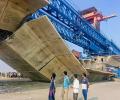
The Supreme Court of India has transferred a Public Interest Litigation (PIL) concerning the safety and longevity of bridges in Bihar to the Patna High Court. The court expressed concern over the state government's handling of bridge collapses, noting that officials were suspended after incidents but reinstated after the public outcry subsided. The court also criticized the state's voluminous response to the PIL, which lacked explanations for the collapses. The Patna High Court will now monitor the state's efforts to ensure structural and safety audits of bridges in Bihar.

The West Bengal government approached the Supreme Court for a second time on Wednesday seeking urgent listing of its petition challenging a Calcutta high court order for transferring to the Central Bureau of Investigation (CBI) the probe into the January 5 attack on an Enforcement Directorate (ED) team in Sandeshkhali but failed to elicit prompt relief.
"Liberty is granted to newly-added respondents (states) to file a response within 15 days from the date of service, and rejoinder if any be filed after 15 days. The interim order to continue and will equally apply to the cases mentioned in the amended writ petition. We direct no further cases be registered without the permission of this court," the bench's order said.
In a significant development, the Supreme Court on Tuesday asked the Election Commission of India to provide details of cases in which it had either removed or reduced the period of disqualification from electoral rolls of leaders post their conviction in criminal cases.
From demonetisation to sub-categorisation of Scheduled Castes to bulldozers, Justice Gavai has been part of several judgments.
A court in Budaun will decide on December 24 whether to proceed with a hearing in the Jama Masjid Shamsi versus Neelkanth temple case. The dispute arose in 2022 when a Hindu group claimed the temple existed at the mosque site and sought permission to worship. The Supreme Court recently restrained all courts from entertaining and passing any orders on lawsuits seeking surveys of religious places under the Places of Worship (Special Provisions) Act, 1991. The Muslim side argues that the lower court should not proceed with the hearing as it cannot pass any orders, while the Hindu side maintains the Supreme Court order does not stop the hearing. The court will now decide whether to continue the proceedings.
The Mathura Shahi Masjid Eidgah Committee has approached the Supreme Court, requesting the court to prevent the central government from filing a response to a petition challenging the Places of Worship Act's constitutional validity. The committee accuses the BJP-led government of intentionally delaying its response. The court had previously issued a notice to the government in March 2021, but the government has yet to submit its reply despite numerous opportunities. The committee argues that the government's delay is intended to obstruct those opposing the challenge to the Places of Worship Act from filing their own responses. The petition also states that the pleas challenging the law's validity are scheduled for hearing on February 17, and closing the government's right to respond would serve justice. The Supreme Court previously issued a ruling in December 2022 that stopped courts from entertaining new lawsuits or issuing interim or final orders regarding the reclaiming of religious places, particularly mosques and dargahs. The ruling halted proceedings in 18 lawsuits filed by Hindu groups seeking surveys to confirm the original religious character of 10 mosques, including the Gyanvapi Masjid in Varanasi, the Shahi Idgah Masjid in Mathura, and the Shahi Jama Masjid in Sambhal. This decision was made in response to six petitions, including one filed by lawyer Ashwini Upadhyay, challenging various provisions of the Places of Worship Act. The 1991 law prohibits the conversion of places of worship and guarantees the preservation of their existing religious character as it stood on August 15, 1947. Notably, the dispute regarding the Ram Janmabhoomi-Babri Masjid in Ayodhya was excluded from this law. There are also several cross-petitions advocating for a strict enforcement of the 1991 law to uphold communal harmony and maintain the current status of mosques that Hindu groups seek to reclaim, claiming they were temples before being destroyed by invaders.
The Supreme Court on Monday said the trial of the Manipur ethnic violence cases, probed by the Central Bureau of Investigation, would be conducted in Guwahati, Assam, where it was transferred to earlier.

A bench of Justices Sanjiv Khanna and Sanjay Kumar issued notice to the Chembur Trombay Education Society, which runs the 'N G Acharya and D K Marathe College', and sought its response by November 18.
The Act prohibits conversion of any place of worship and provides for the maintenance of the religious character of any place of worship as it existed on August 15, 1947.
Justice Gavai's comment came while the apex court bench, also comprising Justice Augustine George Masih, was considering a fresh plea seeking an inquiry into the recent violence in West Bengal during anti-Waqf law protests.
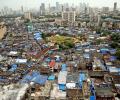
The Supreme Court of India has refused to halt the redevelopment project of Dharavi in Mumbai, allowing the Adani Group to proceed with their project. The court rejected a plea from Seclink Technologies Corporation, the original highest bidder for the project in 2018, which challenged the tender process and the award to Adani Properties Pvt Ltd in 2022. The court directed Adani Properties to make payments through a single bank account and ordered Seclink Technologies to file an affidavit detailing their increased offer for the project. The project work has already commenced, with constructions underway and 2,000 people employed on the site.

He could have blazed a trail that few Indian judges had. It was a missed opportunity of a lifetime, notes Ramesh Menon.
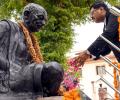
Justice Bhushan Ramkrishna Gavai, India's 52nd chief justice and its first Buddhist one, has played a key role in shaping the judicial landscape, penning about 300 verdicts, including landmark rulings on constitutional issues, liberty, and perhaps most important against the executive's 'bulldozer justice'.
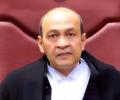
A video and inquiry report have raised questions about the Delhi Fire Services' claim that no cash was found at the official residence of Delhi High Court judge Justice Yashwant Varma during a fire incident on March 14. The video, which has gone viral on social media, shows fire fighters dousing flames on articles that appear to include half-burnt Indian currency notes. The Delhi High Court Chief Justice has initiated an in-house inquiry against Justice Varma and the Supreme Court has proposed his transfer to the Allahabad High Court.
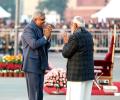
The BJP had no option but to get Jagdeep Dhankhar out of its way for the sake of the Modi government's stability, reveals Sheela Bhatt, the legendary political journalist.
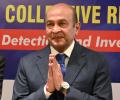
The Allahabad High Court Bar Association has begun an indefinite strike to protest the proposed transfer of Delhi HC judge Yashwant Varma, who is under investigation after a large amount of cash was found at his residence. The Oudh Bar Association (OBA) of the Lucknow bench of the High Court has also condemned the transfer, calling for impeachment proceedings against Justice Varma. Both bar associations are concerned about the impact on public faith in the judiciary and have called for a reconsideration of the transfer decision.
A plea in the Supreme Court of India seeks a direction to Delhi Police to lodge an FIR over the alleged discovery of semi-burnt stash of cash from the official residence of Delhi High Court judge Yashwant Varma. The plea challenges a 1991 judgement that prohibits criminal proceedings against judges without prior consent from the Chief Justice of India, arguing it violates the principle of equality before the law. It also seeks to declare the collegium's 3-member committee investigating the incident as having no jurisdiction and calls for action against corruption within the judiciary.

Chief Justice of India Sanjiv Khanna has recommended the impeachment of Allahabad High Court judge Yashwant Varma following an investigation into a cash discovery incident at his residence. The recommendation follows a report by a Supreme Court-appointed committee that confirmed allegations of cash discovery against Justice Varma. The CJI's recommendation is based on the established in-house procedure for dealing with allegations against judges of constitutional courts.

The Supreme Court has agreed to examine a PIL alleging that Arunachal Pradesh Chief Minister Pema Khandu awarded government contracts to his family members. The court has asked the state government to provide details of the beneficiaries and inform if due process was followed. The bench also sought responses from union ministries of home affairs, finance and the Comptroller and Auditor General of India on the issue within five weeks.
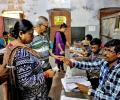
The Supreme Court of India has asked petitioners in two Public Interest Litigations (PILs) to make representations to the Election Commission of India (ECI) regarding their demand for uploading polling booth-wise voter turnout data on the ECI website. The PILs, filed by TMC MP Mahua Moitra and NGO Association for Democratic Reforms, seek a direction for the ECI to upload the data within 48 hours of the conclusion of polling in Lok Sabha and assembly elections. The ECI, represented by senior advocate Maninder Singh, expressed willingness to deliberate on the matter and suggested a meeting with the petitioners to address their concerns. The court has adjourned the hearing to the week of July 28.

The move came hours after Justice Khanna had told Singhvi that Kejriwal's petition against his arrest would be heard by a three-judge bench during the day.
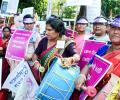
The Supreme Court has allowed the parents of the RG Kar Medical College rape and murder victim to pursue their plea for a further court-monitored CBI probe into the incident before the Calcutta High Court. The parents had expressed dissatisfaction with the CBI's initial probe and sought a more thorough investigation. The court, without making comments, disposed of the application, allowing the parents to continue the proceedings before the high court. The case has also prompted the Supreme Court to consider recommendations for preventing gender-based violence and developing safety protocols for medical staff at hospitals across the nation.

The Supreme Court of India has extended its stay on a court-monitored survey of the Shahi Idgah Mosque complex in Mathura, which is located adjacent to the Krishna Janmabhoomi temple. The court deferred the hearing on a plea against the survey to April 1, while the interim order staying the survey will continue to operate. The Hindu side claims that the mosque complex holds signs of a temple that once existed at the site, while the Muslim side contends that the lawsuits filed by the Hindu litigants violate the Places of Worship (Special Provisions) Act of 1991.
 © 2026 Rediff.com - Advertise with us - Disclaimer - Privacy Policy - Sitemap - Feedback - About us - Terms of use - Grievances